I hear a lot about what’s broken in the economics of online journalism. It’s a topic that’s always coming up at SF happy hours I go to, maybe because so many of my friends are former journalists or passionate news readers. The concerns are real:
- Online journalism isn’t bringing in money the way it used to, and even incredible, award-winning journalists are losing their jobs because of cutbacks.
- Surveillance advertising, which props up many news websites, is creepy at best and predatory at worst.
- Many news organizations can’t afford to invest in long-form investigative journalism. They’re optimizing for clicks, not work that might someday be cited in a congressional hearing.
- Readers can’t afford subscriptions to every news site they visit, leaving some of the best journalism on the web locked behind paywalls.
- And even talented journalists who survive the cuts are leaving the field for the relative stability and financial security of corporate marketing and PR jobs—especially as they think about raising families, buying homes, and putting money into a 401(k).
These are just a few of the headwinds facing modern online journalism. Solving the economics of it is going to take a fundamental shift not only in how we fund journalism but in how readers think about their relationship to the news. And that’s going to take years.
In the meantime, there’s a way to shift the needle on at least one corner of investigative journalism: FOIA based journalism.
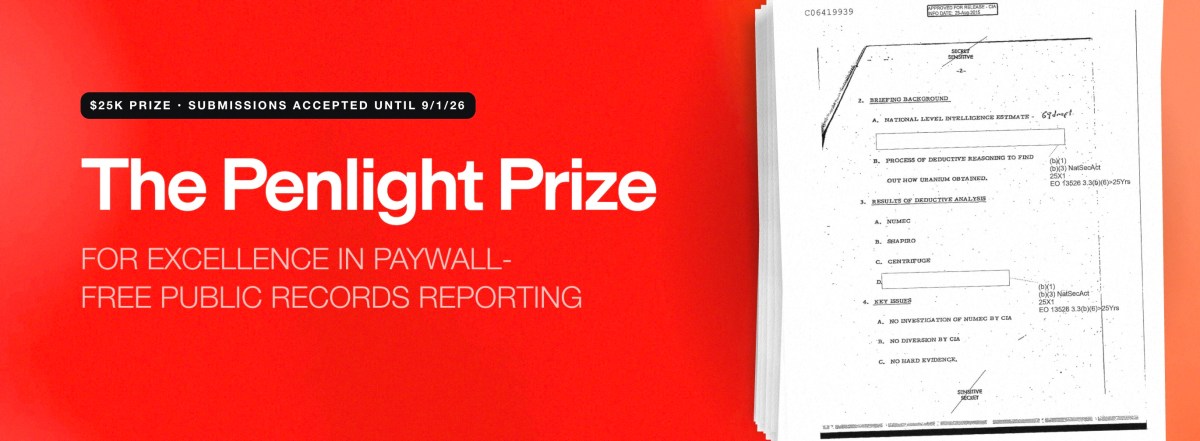
The newly launched Penlight Prize is a $25,000 award for FOIA-based journalism published outside of paywalls.
Journalism based on Freedom of Information Act requests is a particularly meticulous, slow form of journalism. It requires journalists be creative, inquisitive, and above all tenacious. Journalists seeking government records may have to send in requests multiple times, may have to use the court system to fight for access to documents, and may wait years to get responses. When (or frankly if) documents are obtained, those documents are often unstructured, poorly formatted, and difficult to parse—say, thousands of pages all scanned as a single PDF. Making sense of them takes obsessive and careful parsing, sometimes over weeks.
It’s one of the most grueling forms of journalism, and therefore among the most expensive in terms of sheer human hours. Yet the information uncovered through public-records reporting can be extraordinarily important.
Unfortunately, the resulting journalism may still end up behind a paywall, where only a fraction of the public can read it.
Freedom of the Press Foundation has been encouraging news organizations to make FOIA-based journalism freely available so everyone can benefit from reporting based on public records. Now that encouragement comes with a compelling incentive.
I don’t have any illusions that the Penlight Prize can fix what’s wrong with modern journalism. But I do think it can meaningfully change one thing: whether FOIA journalism lives behind a paywall.
My hope is that, in the coming years, publishing FOIA-based investigations outside the paywall becomes the default at news organizations across the country—even when the rest of the publication remains subscription-only.
The $25,000 award is designed to make that incentive meaningful for individual reporters. That is enough money to replace a failing car, cover a year of a child’s daycare in some places, or contribute substantially toward a down payment on a home.
And importantly, the prize goes directly to the journalist, not the publication.
It should serve as an incentive not only for that journalist to keep working on FOIA journalism and publishing outside of paywalls, but to entice other journalists who might be working in the field to work with their editors to get their articles outside of paywalls as well. If enough reporters start asking—and if publications see that paywall-free public-records reporting is something worth recognizing—we can begin to establish a new norm.
Importantly, taking FOIA journalism outside of a paywall doesn’t hurt publications. Wired did it—and their subscriptions increased.
While online journalism is cutting positions and freezing salaries, the Penlight Prize is offering a massive incentive to investigative journalists to get their content outside of paywalls and into the public sphere.
Applications are open right now and close September 1, 2026. Please help spread the word to journalists who might benefit. And if you’re an investigative journalist doing FOIA-based reporting, work with your editor to get your articles outside the paywall and apply.

